
GPT LIVE: The Most Powerful Voice Model Ever
OpenAI unveiled GPT-Live, Cursor integrated Grok 4.5, and Liquid AI introduced Antidoom, advancing AI conversations, coding, and reasoning reliability.

This week in AI, the spotlight is on the rise of more natural AI interactions, increasingly capable developer tools, and breakthroughs in reasoning reliability. From conversational AI that feels closer to talking with a real person to coding assistants powered by next-generation language models and training techniques that eliminate common reasoning failures, the industry is moving toward AI systems that are more intuitive, dependable, and effective in real-world applications.
OpenAI introduced GPT-Live, a next-generation conversational AI experience designed to make interactions feel more natural, responsive, and human-like through real-time voice conversations.
Cursor integrated Grok 4.5 into its AI coding platform, giving developers access to xAI’s latest model for code generation, debugging, refactoring, and large-scale software development alongside other leading AI models.
Liquid AI unveiled Antidoom, an open-source training method that prevents reasoning models from getting stuck in repetitive “doom loops.” Using Final Token Preference Optimization (FTPO), it significantly improves reasoning stability while preserving overall model performance.
Together, these developments highlight how AI is evolving beyond simple chatbots into systems that communicate more naturally, accelerate software development, and deliver more reliable reasoning bringing the next generation of intelligent assistants closer to everyday use.
OpenAI’s GPT-Live Is the Future of AI ConversationsGPT LIve

Meta has unveiled Muse Image, its first AI image generation model developed by Meta Superintelligence Labs (MSL). The model is designed to understand detailed prompts and generate high-quality images while also supporting advanced editing through text instructions, uploaded photos, sketches, and annotations. It can seamlessly combine multiple images, preserve visual consistency, and make precise edits without requiring complex workflows. Muse Image is being integrated into Meta AI, enabling users to create AI-generated content directly within Instagram, Facebook, Messenger, and WhatsApp. Alongside it, Meta also previewed Muse Video, its next-generation AI video generation model. Muse Video is built to produce high-quality videos with improved prompt understanding, realistic motion, better temporal consistency, and native audio generation. Together, Muse Image and Muse Video represent Meta’s latest push into multimodal AI, giving creators and everyday users more powerful tools to generate, edit, and share visual content across the company’s ecosystem.
Cursor Adds Grok 4.5 to Power Smarter AI Coding
Cursor has integrated Grok 4.5 into its AI coding platform, giving developers another powerful model for programming, debugging, and software development tasks. Built by xAI, Grok 4.5 is designed to excel at code generation, complex reasoning, and understanding large codebases, making it a strong option for engineers working on everything from quick bug fixes to large-scale applications. Inside Cursor, developers can now choose Grok 4.5 alongside other leading AI models, allowing them to pick the best model for different coding workflows. The integration also supports Cursor’s AI-powered features such as code completion, refactoring, code explanations, and multi-file editing, helping developers write cleaner code with less effort. By expanding its model lineup, Cursor continues its strategy of offering a flexible AI coding experience rather than relying on a single model. The addition of Grok 4.5 gives users more choice, better performance for demanding programming tasks, and another step toward faster, more intelligent software development.
Liquid AI Introduces Antidoom to Eliminate AI Reasoning Loops
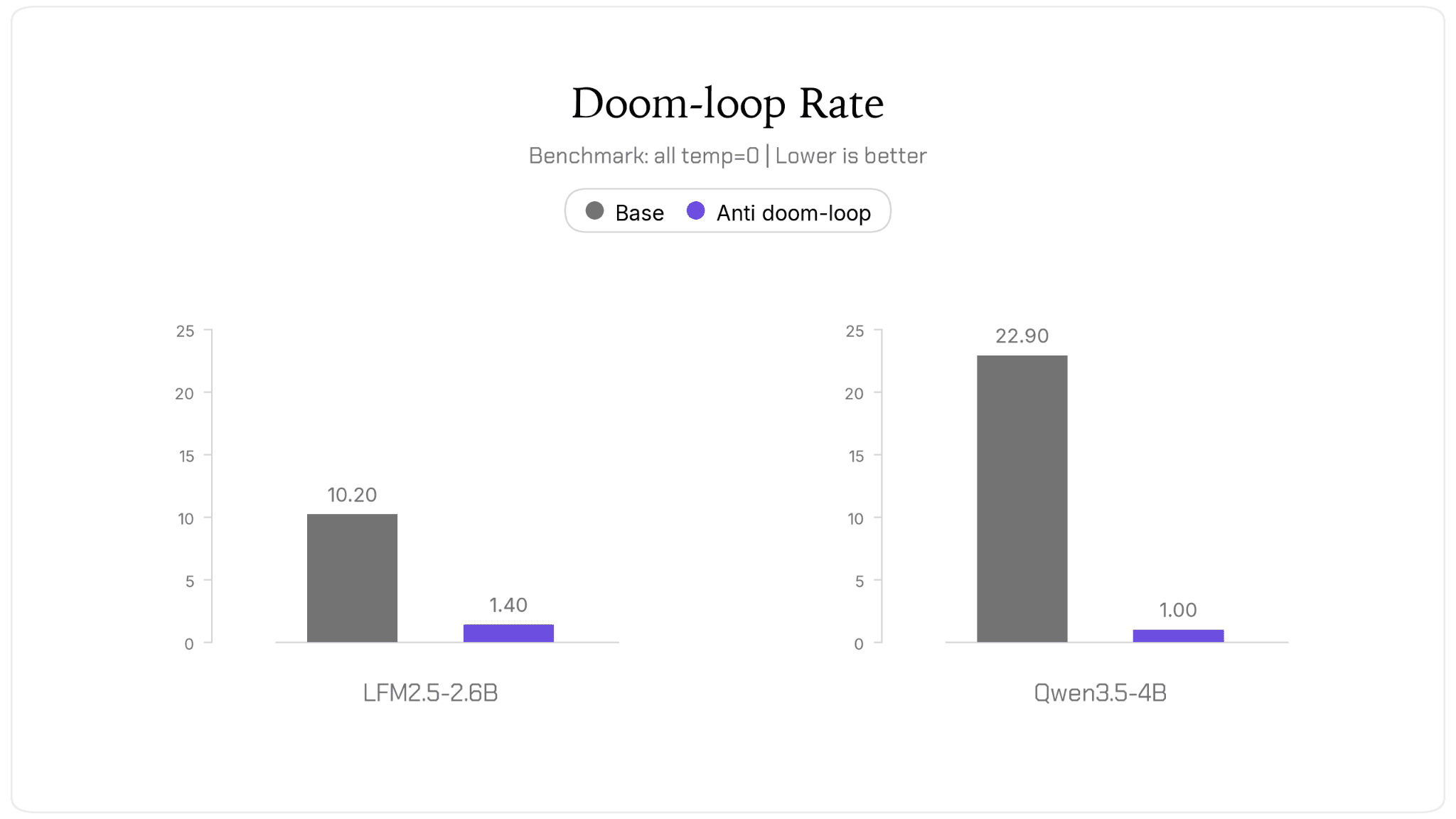
Liquid AI has unveiled Antidoom, an open-source training method designed to fix one of the most common failures in reasoning models—”doom loops,” where an AI repeatedly generates the same phrases until it exhausts its context window. Instead of modifying the entire model, Antidoom uses Final Token Preference Optimization (FTPO) to identify the exact token that starts a loop and trains the model to prefer better alternatives while leaving the rest of the model largely unchanged. This targeted approach significantly improves reliability without sacrificing overall performance. In internal tests, Antidoom reduced looping rates on Liquid AI’s LFM2.5-2.6B model from 10.2% to 1.4%, while Qwen3.5-4B saw an even bigger drop from 22.9% to 1%, leading to higher benchmark scores and more stable reasoning. By open-sourcing the project, Liquid AI aims to help developers build reasoning models that produce more consistent, coherent, and dependable outputs for complex coding, math, and problem-solving tasks.
Hand Picked Video
In this video we’ll look at GPT-OSS, OpenAI’s unexpected open source model that rivals O3 performance, features built-in web search, and how to test it yourself locally.
Top AI Products from this week
ExploreYC - One open-source API for startup data across Y Combinator AND a16z - 6,600+ companies with funding, stage, IPO/M&A exits, and founders. Filter by VC (yc/a16z/all), batch, industry, country, or search.
Willow Frontier Pro - Willow is launching two new voice AI models: Willow Frontier Pro and Willow Frontier Mini. Frontier Pro is our most powerful dictation model. It is built for people who want fast, accurate, and polished writing anywhere they work.
Bono AI - Meet Bono, your voice AI content strategist. Talk for 10 minutes, and Bono turns the conversation into a blog post, LinkedIn/X content, a newsletter, and more, all in your voice. No blank page, no prompts, no ghostwriters, no agencies.
LemonLime - LemonLime lets teams automate their workflows in minutes with a single click. It connects to your existing tools, studies your business, and self-creates specialized AI agents and automations that support your team.
PopTask for Apple - PopTask just went universal .. type a messy thought like “gym mon wed fri 6am” and it becomes a scheduled task in about 3 seconds, no pickers, no forms .. on iphone + ipad you get home and lock screen widgets, a live activity + dynamic island counting down your next task, control center, and hands-free siri even in the car .. on mac it lives in the menu bar (⌘⌃P)
agents cli - One command-line tool to scaffold, evaluate, and deploy AI agents on Google Cloud built to be driven by your coding agent (e.g Antigravity, Claude Code, Codex). Scaffold a production-ready project, evaluate against a real signal, and ship to Agent Runtime, Cloud Run, or GKE or anywhere else!
This week in AI
SpaceXAI Rebrand - Elon Musk’s AI company xAI has officially rebranded to SpaceXAI, introducing a new logo and X handle after merging with SpaceX. The move unifies AI, space, and social platforms under one brand.
Claude Cowork - Claude Cowork lets users assign long-running tasks on web or desktop and continue tracking or collecting results from mobile. It keeps working even after you leave your device, improving productivity.
AI Harness - Lilian Weng introduced Harness, a framework for building reliable AI agents. It focuses on better evaluation, feedback loops, and safer execution, helping developers create more dependable AI systems.
Agentic Coding - Researchers showcased an agentic coding workflow where AI autonomously plans, writes, tests, and improves code across multiple steps, reducing manual intervention while increasing software development efficiency.
DoorDash AI Reviews - DoorDash shared how it built trust in its AI code reviewer by gradually validating suggestions, measuring accuracy, and integrating human feedback before expanding AI-assisted code reviews across engineering teams.
Paper Of the day
A new research paper explores how AI systems can increasingly improve themselves through iterative learning. Instead of only refining individual responses, future AI could modify its own tools, generate training data, optimize workflows, and even conduct AI research with minimal human intervention. The paper introduces a framework that distinguishes simple self-refinement from more advanced autonomous research loops, helping researchers better understand the path toward truly self-improving AI systems while highlighting the need for safety, oversight, and reliable evaluation.
Read this whole paper 👉 here