
Laguna XS 2.1 Open Coding Model Is Here
Poolside launched Laguna XS 2.1, research explored continuously learning AI, and Apple introduced ReCo, enabling longer, more efficient AI video generation.

This week in AI, the spotlight is on more efficient coding models, the future of continuously learning AI, and breakthroughs in scalable video generation. From lightweight developer-focused models to research shaping next-generation AI systems, the industry continues to push beyond traditional language models.
Poolside introduced Laguna XS 2.1, an upgraded open coding model with a 262K-token context window, efficient Mixture-of-Experts architecture, and local deployment support for building powerful AI coding agents.
New research on continuously learning AI highlights a future where models improve from real-world experience after deployment, enabling long-term memory, adaptation, and more autonomous AI systems.
Apple unveiled Residual Context Diffusion (ReCo), a new technique that generates longer, more consistent AI videos while dramatically reducing memory usage, making high-quality video generation more scalable.
Together, these developments show AI evolving toward systems that are more efficient, adaptive, and capable of tackling increasingly complex real-world tasks across software development, autonomous agents, and generative media.
Poolside Introduces Laguna XS 2.1: A More Efficient Open Coding Model
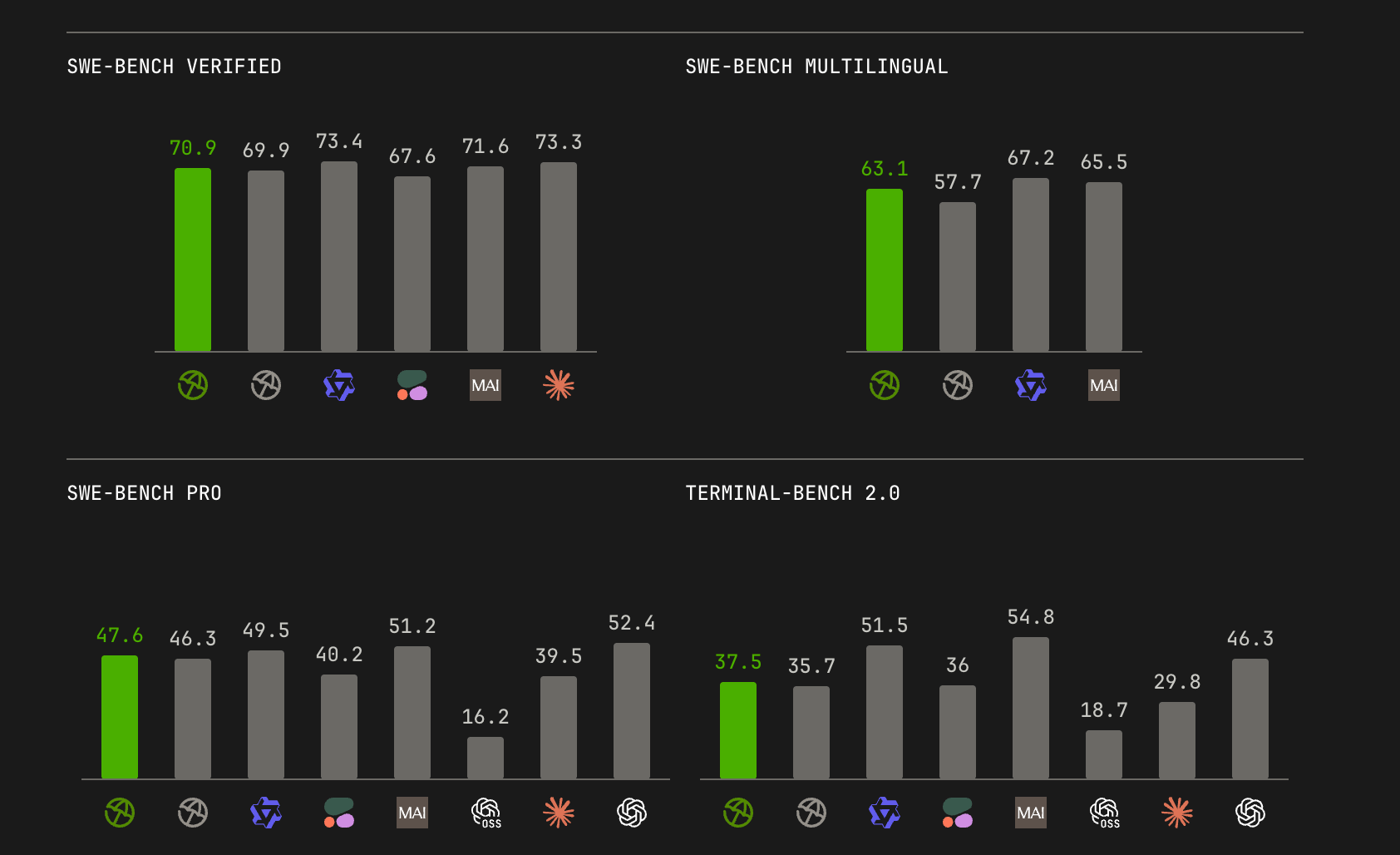
Poolside has unveiled Laguna XS 2.1, an upgraded version of its open coding model built for agentic software development and long-horizon coding tasks. The 33B-parameter Mixture-of-Experts (MoE) model activates only 3B parameters per token, enabling efficient performance while remaining lightweight enough to run on a local machine. The update brings a larger 262K-token context window, improved inference efficiency through Sliding Window Attention, and optimized memory usage, making it well-suited for handling massive codebases and complex development workflows. Available in multiple quantized variants, Laguna XS 2.1 supports local deployment, tool use, and function calling, giving developers a powerful open model for building AI coding agents with lower hardware requirements and greater flexibility.
Introducing Devin Security Swarm
A recent discussion highlights that the next major breakthrough in AI may not come from larger or more powerful language models, but from giving them the ability to learn continuously after deployment. Instead of relying solely on knowledge gained during training, future AI systems could improve from real-world experience, adapt to new environments, refine their own skills, and build long-term memory over time. Unlike today’s models, which require retraining to incorporate new knowledge, these systems could update themselves through ongoing interactions and feedback. This approach would make AI more personalized, reliable, and capable of handling dynamic real-world challenges. It also lays the foundation for truly autonomous AI agents that can evolve over months or even years, unlocking applications that go far beyond today’s chatbots and coding assistants.
Apple Introduces a Smarter Way to Generate Long AI Videos

Apple researchers have introduced Residual Context Diffusion (ReCo), a new technique that helps diffusion models generate longer, more consistent videos without overwhelming GPU memory. Instead of storing every previous frame, ReCo compresses past visual information into a lightweight residual context, allowing the model to preserve object appearance, motion, and scene consistency over extended sequences. This significantly reduces memory requirements while maintaining high-quality video generation. The approach also enables scalable video synthesis, making it easier to create longer clips without sacrificing performance or visual coherence. Apple’s research demonstrates that ReCo outperforms existing methods in balancing efficiency, temporal consistency, and generation quality, marking an important step toward more practical and scalable AI video generation. The method is compatible with existing diffusion architectures, making it easier to integrate into current AI video pipelines. It could also accelerate the development of next-generation video generation systems capable of producing longer, more realistic, and cinematic AI-generated content.
Hand Picked Video
In this video, we explore the latest sample videos from happyhorse.com from multi-image character consistency to timestamped prompt control and see how far AI video generation has come since the Will Smith noodles era.
Top AI Products from this week
Vida - Vida is an AI that learns how you work, remembers what matters, and becomes more like you over time. The more you use Vida, the more it understands your habits, your projects, and your way of getting things done.
ChecklistFox - Type a prompt, get a beautiful planner. Choose a theme that feels like you, then download as a PDF. Built for weddings, hajj, new babies, big moves, and everything in between.
Narration Room - Narration Room is a native Mac app, not just a text-to-speech box. It turns source text into editable multi-voice scripts, then lets creators cast voices, adjust delivery, preview on a visual timeline, and export polished audio.
CentryAI - I built CentryAI because I have ADHD and was paying for 11 subscriptions I hadn’t used in months. Most trackers make you enter everything manually that doesn’t work if you’ve forgotten what you’re paying for.
Termi Protocol - The Termi Protocol is a 3D simulation of AI agent workflows. Give your coding agents a face, a desk and a living room. Watch them read, write and run commands live in 3D, like a game. You run the agents; we visualize the process.
GraviSync - GraviSync lets you securely connect to your Antigravity IDE agent from any device. Scan a QR code to monitor progress, approve actions, send prompts, attach screenshots, and reference project files all from your phone. Whether you’re away from your desk or simply want to keep an eye on long-running tasks, GraviSync keeps you connected without interrupting your workflow.
This week in AI
Meta’s Watermelon Model - Meta’s AI researcher says the Watermelon reasoning model has caught up to GPT-5.5 on key benchmarks, highlighting Meta’s rapid progress in building advanced reasoning-focused AI systems.
AI Voice Clones Fool Most People - A new study found that people struggle to tell AI-generated voice clones from real human voices. The findings highlight growing risks around deepfake scams, fraud, and digital impersonation, emphasizing the urgent need for stronger detection tools and public awareness.
Anthropic Eyes Custom AI Chips - Anthropic is reportedly in talks with Samsung to develop custom AI chips, aiming to reduce reliance on NVIDIA and improve the efficiency and cost of training future AI models.
ByteDance Launches Seed 2.0 - ByteDance unveiled Seed 2.0, a new frontier AI model with stronger reasoning, vision, search, and instruction following, delivering better performance across real-world tasks and benchmarks.
Cursor Launches Evals - Cursor introduced Evals, a new SDK that lets developers run the same AI coding agent behind Cursor on their own benchmarks, making it easier to test, compare, and improve coding models.
Paper Of the day
Researchers have introduced Online Safety Monitoring for LLMs, a framework that continuously checks AI model outputs during deployment instead of relying only on safety measures applied during training. The system uses an external verifier to evaluate responses in real time and triggers an alert whenever the model’s behavior exceeds a predefined safety risk threshold. By calibrating these thresholds with statistical risk control, the approach offers measurable safety guarantees while minimizing false alarms. Unlike traditional alignment methods, it provides continuous oversight, making it easier to detect when an AI system begins producing unsafe or unreliable content. This work could play a key role in improving the reliability of AI assistants deployed in high-stakes applications, where ongoing safety monitoring is just as important as initial model alignment.
Read this whole paper 👉 here