
Microsoft Introduced a Cybersecurity AI Model
Microsoft launched MAI-Cyber-1-Flash for security, Anthropic backed open-weight AI with targeted controls, and Cogent unveiled VR-1 to map enterprise cyber attack paths

This week in AI, the spotlight is on cybersecurity defense, AI governance, and specialized reasoning models. From Microsoft introducing MAI-Cyber-1-Flash, to Anthropic clarifying its stance on open-weight models, and Cogent launching VR-1, AI continues to become more resilient, transparent, and security-focused.
Microsoft unveiled MAI-Cyber-1-Flash, its first specialized cybersecurity model built to power MDASH. By handling 90% of routine security tasks alongside models like GPT-5.4, it cuts inference costs by 50% while scoring 96% on the CyberGym benchmark.
Anthropic clarified its stance on open-weight AI, opposing blanket bans and calling open models a public good. CEO Dario Amodei advocated for targeted safeguards instead, focusing on chip controls, distillation limits, and mandatory safety testing for high-risk frontier systems.
Cogent introduced VR-1, a frontier reasoning model built to map complex, multi-system attack paths across enterprise networks. Released alongside IntrusionBench and the Cogent AI Harness runtime, VR-1 slashes deep security analysis time from weeks to hours.
Together, these updates show how AI is becoming more resilient against cyber threats, better governed for safe open-weight deployment, and increasingly specialized for complex enterprise security challenges.
Microsoft Introduces MAI-Cyber-1-Flash to Strengthen AI-Powered Cybersecurity
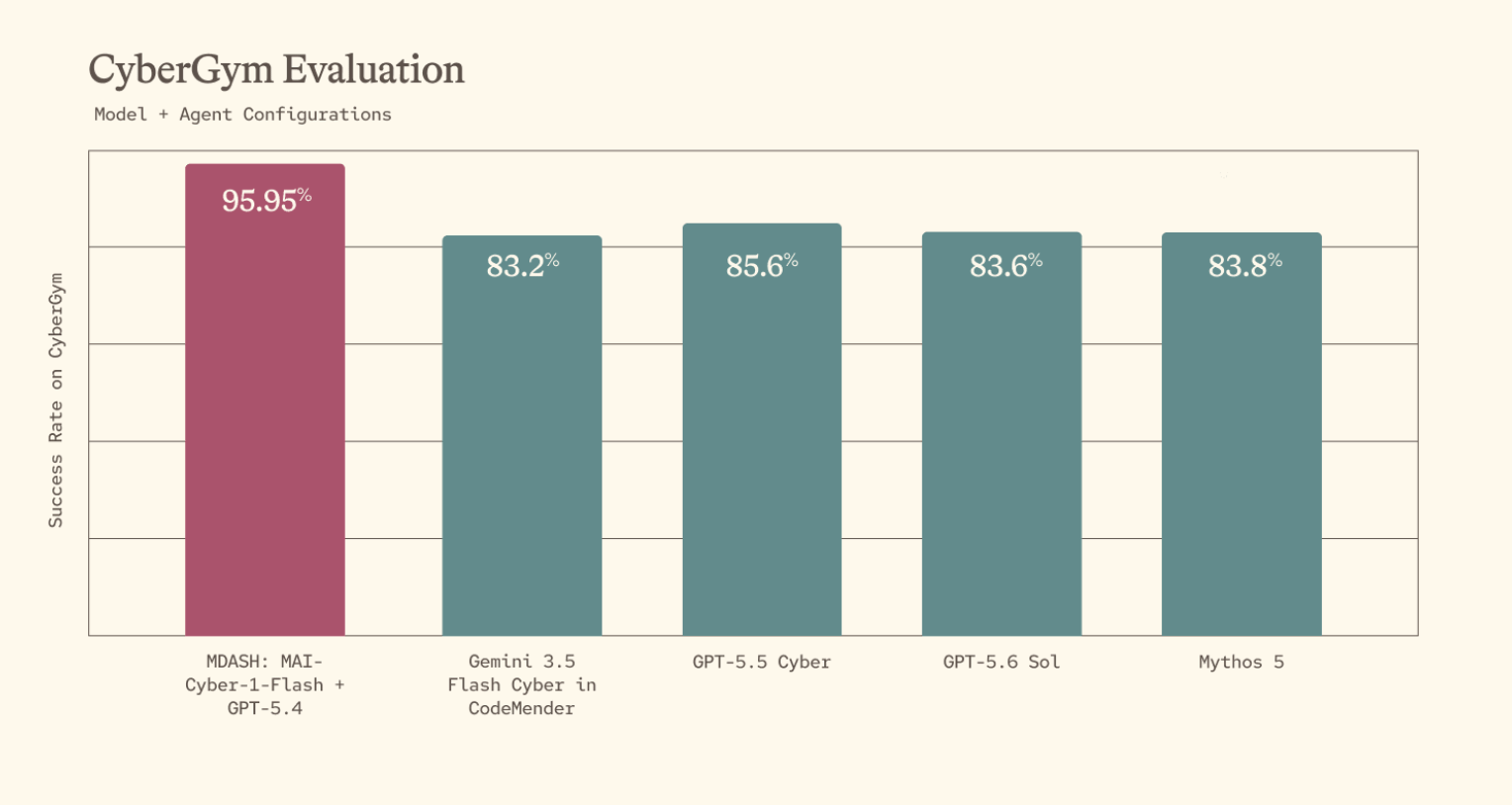
Microsoft has unveiled MAI-Cyber-1-Flash, its first AI model built specifically for cybersecurity, designed to power MDASH, the company’s multi-agent vulnerability detection and remediation system. The lightweight model handles up to 90% of security analysis tasks, allowing larger models like GPT-5.4 to focus only on the most complex vulnerabilities. This hybrid approach delivers 96% on the CyberGym benchmark while reducing inference costs by around 50% compared to using large models alone. Built on Microsoft’s extensive security intelligence and orchestrated through more than 100 specialized AI agents, MAI-Cyber-1-Flash helps security teams discover, validate, prioritize, and remediate software vulnerabilities faster, enabling enterprises to defend against increasingly sophisticated AI-driven cyber threats
Anthropic Clarified Its Position on Open-Weight AI Models

Anthropic CEO Dario Amodei has clarified the company’s stance on open-weight AI models, emphasizing that Anthropic does not support banning open-weight models and considers many of them a public good for developers, researchers, and businesses. Instead of broad restrictions, the company advocates for targeted safeguards focused on the most capable AI systems, regardless of whether they are open or closed. Anthropic recommends stricter controls on advanced AI chips, stronger action against large-scale model distillation, and mandatory safety testing for frontier AI models with significant cyber, biological, or national security risks. The statement aims to balance AI innovation with responsible governance while addressing growing concerns around the misuse of increasingly powerful AI systems.
Cogent Unveils VR-1: A Frontier AI Model Built for Cyber Defense
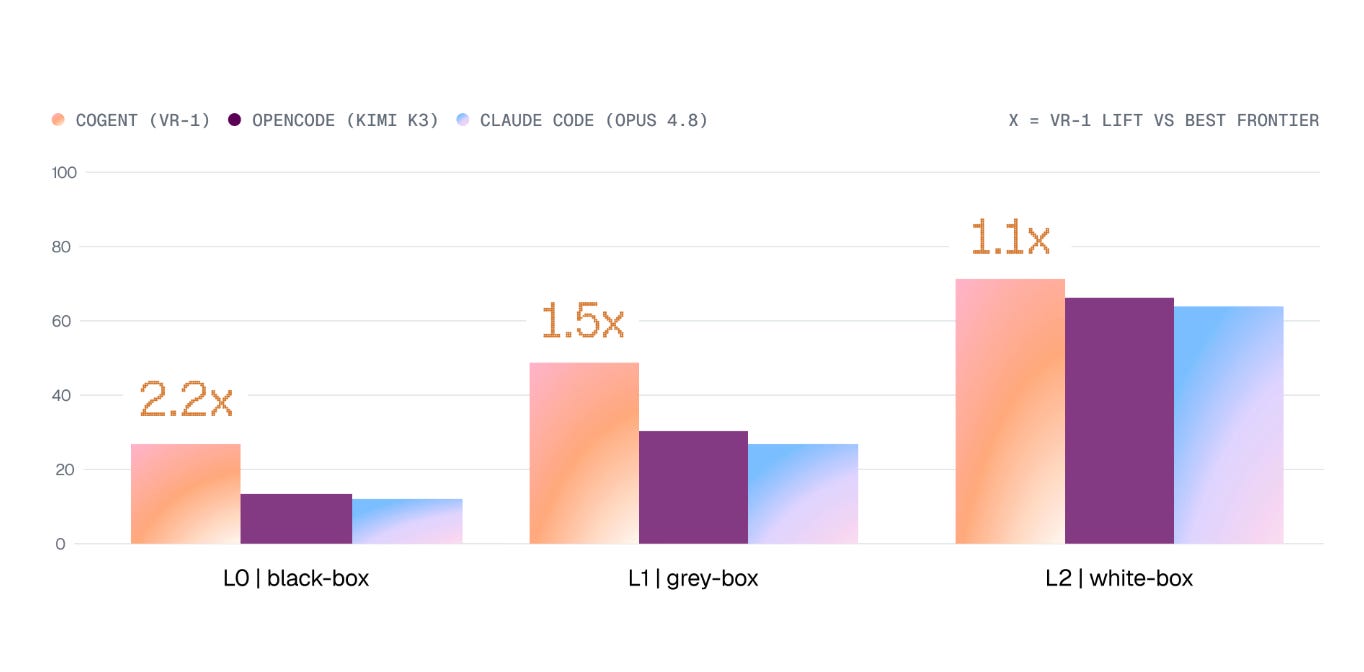
Cogent has introduced VR-1, a frontier AI reasoning model designed specifically for enterprise cybersecurity. Unlike general-purpose AI models that focus on finding isolated vulnerabilities, VR-1 is trained to identify and connect multiple weaknesses across cloud infrastructure, identity systems, applications, and enterprise networks to uncover realistic attack paths. The model can autonomously investigate complex environments, validate whether security fixes actually eliminate risks, and significantly reduce the time required for advanced security analysis—from weeks to just hours. Alongside VR-1, Cogent also released IntrusionBench, a new benchmark for enterprise cyber reasoning, and the Cogent AI Harness, a governed runtime that enables secure deployment of AI agents in production environments with policy enforcement and verification. According to Cogent, VR-1 outperformed other frontier models on enterprise attack path discovery while operating at a much lower cost, marking a significant step toward AI-powered cyber defense.
Hand Picked Video
In this video, we introduce Video Intelligence BGBlur’s new AI feature that lets you upload any video and chat with it directly to pull out insights, summaries, and answers. This feature is part of BGBlur’s growing privacy and video-intelligence ecosystem the same platform known for AI-powered face blur, license plate blur, background blur, and face anonymization.
Top AI Products from this week
Totem - You bookmark great threads on X and never see them again. Totem turns your new tab into a distraction-free environment for those bookmarks, the way you’d read on Substack. Open a thread full-width, highlight what matters, search everything, export etc.
Vela - Vela is an AI recruiting coordinator. Cc it on any email thread and it takes over: candidate screens, multi-round loops, and full panels. It offers times, chases people who go quiet, handles reschedules, sends the resume with the invite, books prep calls, and collects feedback.
Bo AI - Bo is the first consumer AI product that exists to serve everyday people. Bo helps you stay organized, save time, live healthier, and answer your questions—all via text.
Webhound - Research has no natural finish line. An agent can spend ten minutes or ten hours on the same question, and both answers can look finished. Webhound lets you choose how much work the question deserves. Give it a question and a dollar budget.
/mission for Claude Code - Medley is a free Claude Code plugin for work bigger than one session. Type /mission to turn an outcome into a live graph, coordinate Claude Code and Codex workers, review the result, and keep going. BYOK via OpenRouter for Kimi, GLM, and more.
MemoryCustodian - MemoryCustodian gives Codex, Claude Code, Gemini, and other coding agents durable project memory without a hosted service or bloating every prompt. Decisions, constraints, rejected approaches, and project context live as plain Markdown in your repo, where they can be reviewed, versioned, shared, and deleted like code.
This week in AI
Rokid Unveiled AI Smart Glasses - Rokid showcased AIOS-powered smart glasses and a new AR spatial computing device at WAIC 2026, featuring AIUI, on-device AI, 6DoF tracking, and Unreal Engine 5 support.
Inclusion AI Released LLaDA 2.X - Inclusion AI launched LLaDA 2.X, an open large language diffusion model family that improves reasoning, coding, and multilingual performance while supporting efficient inference.
Black Forest Labs Released FLUX.3 - Black Forest Labs introduced FLUX.3, a next-generation image generation model offering improved prompt accuracy, faster generation, and higher-quality visual outputs.
Moonshot AI Open-Sourced Kimi K3 - Moonshot AI released Kimi K3 on Hugging Face, delivering a powerful open-weight foundation model with strong reasoning, coding, and multilingual capabilities.
Ramp Released Open Finance Models - Ramp open-sourced specialized AI models for finance on Hugging Face, enabling developers to build applications for expense management, accounting, and financial workflows.
Paper Of the day
Researchers have proposed a new self-distillation framework that helps large language models learn more effectively from their own mistakes. Instead of relying only on successful outputs, the approach creates micro-reflective trajectories—small, targeted reasoning corrections that explicitly identify errors and demonstrate how to fix them. This allows the model to understand why a response was wrong rather than simply imitating better answers. Experiments show the method significantly improves reasoning accuracy, generalization, and overall performance across multiple benchmarks, making self-improving AI systems more efficient without requiring additional human-generated training data.
Read this whole paper 👉 here