
OpenAI Releases GPT-5.6
OpenAI launched GPT-5.6, Anthropic introduced Reflect with Claude, and Meta unveiled Muse Spark for faster AI development.

This week in AI, the spotlight is on the emergence of more capable AI workspaces, deeper reasoning capabilities, and faster developer-friendly models. From AI systems built to handle complex professional tasks and collaborative thinking to lightweight models that enable efficient application development, the industry is moving toward AI that is more practical, reliable, and ready for real-world deployment.
OpenAI introduced GPT-5.6, its latest AI model family featuring stronger reasoning, improved reliability, and ChatGPT Work, a new AI workspace that automates documents, coding, presentations, and business workflows through powerful integrations.
Anthropic launched Reflect with Claude, a new capability that encourages thoughtful, collaborative problem-solving by allowing Claude to evaluate multiple possibilities, ask clarifying questions, and deliver more structured and reliable responses.
Meta unveiled Muse Spark, a family of lightweight AI models available through the Meta Model API, enabling developers to build fast, scalable, and cost-efficient AI applications with low latency and simplified deployment.
Together, these developments highlight how AI is evolving into a more capable productivity partner—combining advanced reasoning, intelligent collaboration, and efficient deployment to help professionals and developers build, think, and work more effectively.
OpenAI Unveils GPT-5.6: Smarter AI Built for Real-World Work

OpenAI has introduced GPT-5.6, its latest generation of AI models designed to deliver stronger reasoning, faster performance, and greater reliability across coding, scientific research, cybersecurity, and professional knowledge work. The new model family includes Sol, the flagship model for advanced reasoning, Terra for balanced everyday tasks, and Luna, a lightweight version optimized for speed and cost efficiency. Alongside the release, OpenAI also announced ChatGPT Work, an AI workspace that combines ChatGPT with Codex to automate tasks such as creating documents, spreadsheets, presentations, websites, and handling workflows through integrations with tools like Gmail, Slack, Google Drive, and CRMs. GPT-5.6 introduces enhanced safety measures, improved prompt caching, and lower operating costs for developers, making it one of OpenAI’s most practical AI releases to date. The rollout is being phased in, with early access available for Pro, Enterprise, and Edu users before expanding to more users in the coming weeks.
Anthropic Introduces Reflect with Claude

Anthropic has launched Reflect with Claude, a new capability designed to help users think through complex problems instead of simply receiving instant answers. The feature encourages a more collaborative approach by allowing Claude to pause, evaluate multiple possibilities, and refine its reasoning before responding. This results in more thoughtful, structured, and reliable outputs for tasks such as brainstorming, strategic planning, writing, coding, research, and decision-making. Rather than acting as a traditional chatbot, Reflect with Claude functions like an AI thinking partner—asking clarifying questions, exploring trade-offs, and helping users reach well-reasoned conclusions. The feature is particularly valuable for professionals, students, researchers, and teams working on high-stakes or nuanced projects where careful analysis matters. By emphasizing reflection over speed, Anthropic aims to improve response quality, reduce mistakes, and create more transparent interactions, marking another step toward AI systems that support deeper human thinking and better decision-making.
Meta Introduces Muse Spark for Faster AI Development
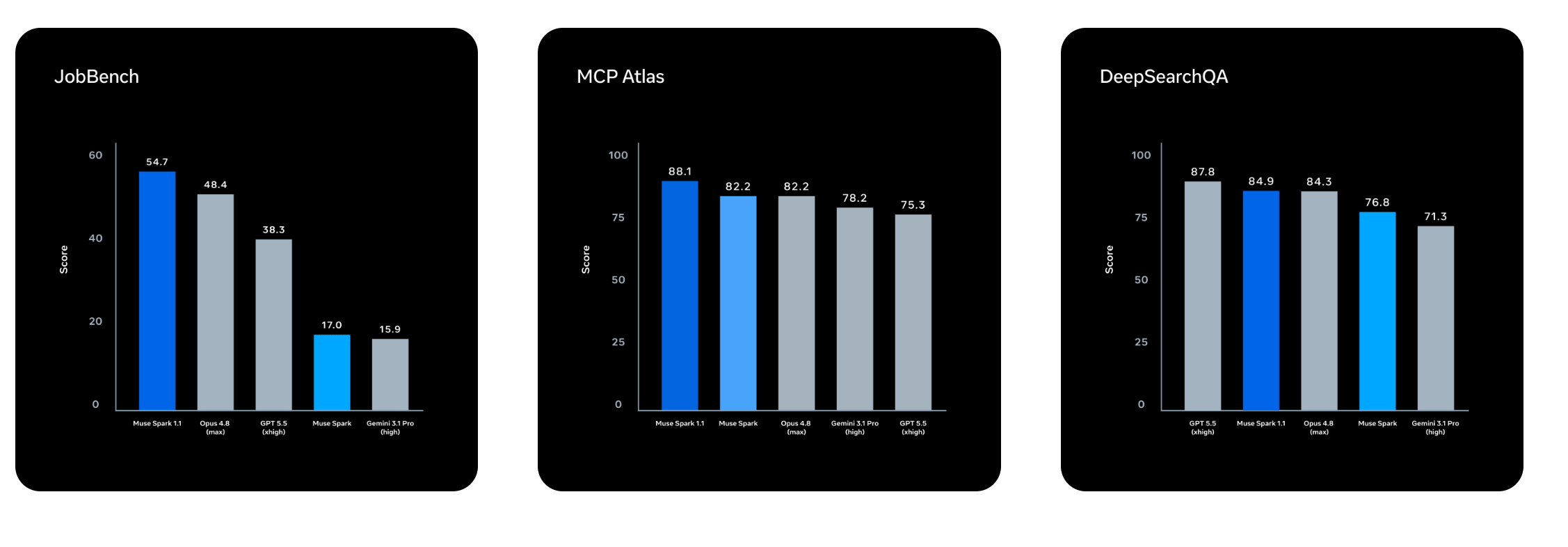
Meta has unveiled Muse Spark, a new family of lightweight AI models available through the Meta Model API, making it easier for developers to build fast, intelligent, and cost-efficient AI applications. Designed for real-world deployment, Muse Spark delivers strong performance while requiring fewer computing resources, making it ideal for chatbots, content generation, coding assistants, document analysis, and enterprise workflows. Through the Meta Model API, developers can quickly integrate Muse Spark into their applications with scalable infrastructure and simplified deployment. The models are optimized for low latency, enabling responsive AI experiences without sacrificing quality. By combining efficient model architecture with accessible APIs, Meta aims to help businesses and developers create production-ready AI solutions faster while reducing operational costs. Muse Spark reflects Meta’s continued focus on making powerful AI models more practical, accessible, and easier to deploy across a wide range of industries and use cases.
Hand Picked Video
In this video, we’ll look at real-world GPT-5 use cases from coding and writing to reasoning and research to see if it truly lives up to the hype and how it stacks up in everyday tasks.
Top AI Products from this week
Auriko - Auriko treats LLM providers as trading venues and arbitrages the spread. Built by ex-quant traders, Auriko’s cost-arbitrage engine calibrates to each user’s request patterns and selects optimized inference paths based on token price, cache behavior, latency, reliability, and request quality.
Timbal AI - Timbal helps teams turn AI prototypes into production systems. Build agents and workflows, connect them to your data, design interfaces, deploy, monitor, evaluate, and govern everything from one platform.
Just Ask by SEORCE - SEO software has looked the same for 20 years: log in, open dashboards, build reports, find answers. We think it’s time for a new interface. SEORCE lets you chat with your SEO, GEO, Analytics, Backlinks and AI Visibility data directly on WhatsApp.
Lispr - Lispr is a free voice dictation and translation app for Mac and Windows. Hold a key, speak, release. Your words land in whatever app your cursor is in. Speak in ~99 languages and switch mid-sentence. Hold your translation key as well, and the translation lands instead, in any of 32 languages.
Toyo - Toyo is a personal AI assistant that lives in your messages and can call you on the phone. Talk to it like you’d message a coworker. Toyo triages your inbox, preps you for calls, can help keep your projects moving, and pulls answers and context from your company’s tools.
Opper AI - One API key to 300+ models, hosted in the EU. Drop-in compatible with the OpenAI, Anthropic, and Google SDKs: switching is a base URL change. What’s different: ~half our 30+ providers run inference in Europe, one EU sub-processor covers every model, no prompts stored by default.
This week in AI
ByteDance Launches Seedream 5.0 Pro - ByteDance introduced Seedream 5.0 Pro, a multimodal image generation model featuring advanced reasoning, precise editing, multilingual support, and professional design capabilities for creators and developers.
OpenAI Unveils GPT-5.6 - OpenAI launched GPT-5.6 with Sol, Terra, and Luna models, delivering stronger reasoning, faster performance, lower costs, and powering the new ChatGPT Work experience for enterprise productivity.
Prime Intellect Raises $130M - Prime Intellect secured a $130M Series A to accelerate its open superintelligence stack, expanding infrastructure and tools that help organizations build and train their own AI agents.
Google Enhances Gemini Reasoning - Google researchers unveiled a new reinforcement learning approach that improves Gemini’s reasoning by enabling better self-correction, long-horizon planning, and more reliable problem-solving across complex tasks.
Paper Of the day
Researchers introduced a new reasoning framework that teaches AI models to pause, evaluate their intermediate steps, and refine their thinking before generating a final response. Instead of relying on a single pass, the system performs self-reflection to detect mistakes, improve logical consistency, and enhance decision-making. The approach delivers stronger performance on complex reasoning, mathematics, planning, and coding tasks, reducing errors while making AI outputs more reliable, transparent, and closer to human-like problem-solving.
Read this whole paper 👉 here