
Thinking Machines debuts its first open-weight model
Claude adapts to languages, LangChain builds shared agent memory, and Microsoft debuts multi-model cybersecurity.

This week in AI, the spotlight is on customizable open-weight foundations, bulletproof agent infrastructure, and the dawn of autonomous self-evolution. From Mira Murati’s new venture introducing a massive alternative to centralized, one-size-fits-all AI, to Perplexity launching isolated digital environments for agents to safely execute real-world tasks, and WeCo proving that AI can independently upgrade its own architecture, the industry is shifting from static chatbots toward highly secure, self-improving autonomous ecosystems.
Thinking Machines launched Inkling, an open-weight multimodal model with 975 billion total parameters and a 1-million-token context window. Natively reasoning across text, images, and audio, it focuses on extreme enterprise customization via the Tinker platform rather than raw benchmark chasing.
Perplexity introduced SPACE, an ephemeral sandbox platform designed for AI agents to execute code and process files safely. By utilizing strict isolation primitives and a zero-trust credential setup, the architecture gives developers secure, stateful environments to run complex, long-horizon workflows without exposing production data.
WeCo researchers achieved a major milestone by demonstrating recursive self-improvement in their AIDE² agent. Running a dual-loop framework over 100 unattended steps, the AI continuously optimized its own inner logic and code, ultimately outperforming a benchmark agent that human engineers spent two years hand-tuning.
Together, these updates highlight a profound structural evolution in the tech landscape: AI is transitioning from static, human-dependent software into dynamic, self-governing infrastructure. As open-weight alternatives become highly tailorable bases for developers, the arrival of secure sandboxes and recursive feedback loops ensures that tomorrow’s AI will not just be more accessible—it will be secure enough to operate autonomously and capable of upgrading itself on the fly.
Thinking Machines Unveils Inkling, Its First Open-Weight AI Model
Thinking Machines, the AI startup founded by former OpenAI CTO Mira Murati, has introduced Inkling, its first open-weight multimodal foundation model. Built with 975 billion total parameters (41 billion active), Inkling can understand text, images, and audio, supports a massive 1 million-token context window, and is designed for advanced reasoning, coding, and agentic workflows. Rather than chasing benchmark leadership, the company is positioning Inkling as a highly customizable AI that developers and enterprises can fine-tune using its Tinker platform. Thinking Machines also demonstrated the model’s ability to fine-tune itself, showcasing a future where AI systems can iteratively improve their own capabilities. By making the model weights openly available, the company aims to give developers greater control over AI while offering a strong alternative to proprietary models.
Perplexity Introduces Secure Sandboxes for AI Agents

Perplexity has launched Secure Sandboxes, a new execution environment that allows AI agents to safely run code, process files, and interact with external tools in isolated, temporary workspaces. Each sandbox is designed with strict security boundaries, preventing unauthorized access to user data or underlying systems while enabling complex tasks such as data analysis, document processing, coding, and workflow automation. By combining secure code execution with its AI capabilities, Perplexity aims to make autonomous agents more reliable for both developers and enterprise users, providing a safer foundation for building powerful AI-driven applications. The sandboxes are ephemeral by default, meaning they are automatically destroyed after a session ends, minimizing security risks and data persistence. They also feature network controls, resource limits, and permission-based access, giving developers fine-grained control over what AI agents can do. This infrastructure enables AI agents to execute real-world tasks with greater confidence while maintaining strong isolation and enterprise-grade security.
WeCo Demonstrates Recursive Self-Improvement in AI
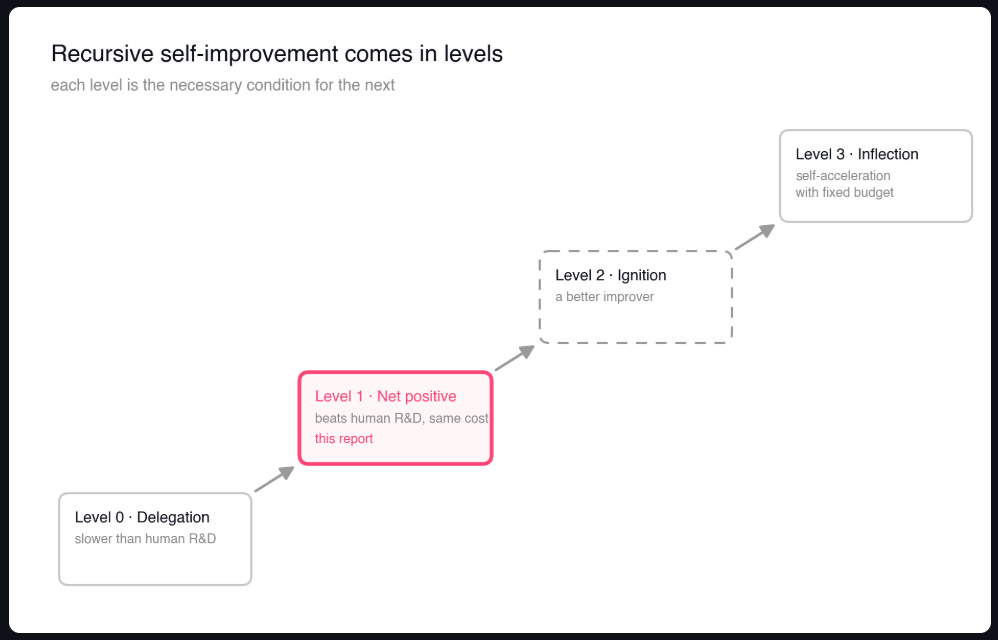
Researchers at WeCo have presented what they describe as the first evidence of recursive self-improvement, where an AI model enhances its own performance by repeatedly generating, evaluating, and refining its outputs without requiring a stronger external model. Using an automated feedback loop, the system was able to improve reasoning, coding, and problem-solving capabilities over multiple iterations, suggesting that AI can progressively optimize itself with minimal human intervention. The study highlights a significant step toward more autonomous AI systems that continuously learn and adapt from their own work. Rather than relying solely on larger models or additional training data, recursive self-improvement allows models to identify weaknesses, generate better solutions, and iterate on them independently. While the results are still early-stage, the research points to a future where AI systems can accelerate their own development, potentially reducing training costs and speeding up innovation in advanced AI agents.
Hand Picked Video
In this video, you'll discover how to go from knowing nothing about AI to building real-world AI applications in just 6 weeks. As AI continues to transform industries, the biggest advantage belongs to those who know how to use it effectively. Instead of watching from the sidelines, now is the time to build skills that matter.
Top AI Products from this week
Weave - Talk through an idea and watch it become a live map that reshapes as you change your mind and asks the questions you haven’t thought to ask. Capture meetings, replay how a thought unfolded, share a link, export anywhere. Free to start, no card.
FlightGlitch - FlightGlitch finds $900 flights for $140 by monitoring airline pricing errors 24/7. Get instant cheap flight alerts today.
Crustdata Recruiter - A set of recruiting skills that runs inside Claude on live data from 1B+ profiles from Crustdata. It learns your judgement with every search, ranks candidates the way you would, explains every candidate it picks, and drafts outreach into your ATS.
SonOf - Connect your repo and PM tools. SonOf audits the codebase, writes and estimates the tickets, and ships the ones you approve. A senior engineer signs every plan and reviews every PR. Billed only when code hits production. Rejected work costs $0.
ChikitAI - ChikitAI is the healthcare agentic AI by NyuktAI that automates healthcare’s messiest bottleneck: patient intake and triage, increasing patient intake capacity by 30% for healthcare providers.
Ventorah - Upload a 3D model and run virtual wind tunnel aerodynamic analysis in your browser. Streamlines, pressure fields, lift & drag Ventorah brings CFD to the cloud.
This week in AI
Luma AI Introduces Reframe - Luma AI launched Reframe, a video editing model that intelligently changes camera angles, framing, and composition while preserving motion, helping creators transform footage with AI.
Anthropic Launches ODE for Enterprise AI - Anthropic, Blackstone, and Hellman & Friedman introduced ODE, a new enterprise AI services firm that helps organizations deploy, customize, and scale AI solutions securely.
Suno Accused of Using Music Platform Data - AI music startup Suno allegedly accessed data from YouTube Music, Deezer, and Genius to improve its models, raising fresh concerns over AI training practices and copyright.
Apple Develops PrismML for On-Device AI - Apple is developing PrismML, an AI model compression technique that enables more powerful AI features to run directly on iPhones with lower memory and processing demands.
Paper Of the day
Researchers have introduced AutoSynthesis, an end-to-end multi-agent AI system designed to automate the entire meta-analysis process from understanding a research question and searching scientific literature to extracting data, assessing study quality, and generating statistical evidence. Instead of assisting with just one step, the system coordinates multiple specialized AI agents to perform the complete evidence synthesis workflow with m1`inimal human intervention. AutoSynthesis aims to dramatically reduce the time and effort required to produce high-quality systematic reviews, a process that traditionally takes researchers months to complete. By automating evidence collection, analysis, and reporting, the framework could help accelerate discoveries in medicine, education, and public policy while making large-scale scientific research more efficient, reproducible, and accessible.
Read this whole paper 👉 here