
World’s First Real-Time AI World Model by Odyssey
Odyssey’s interactive world models, Google’s real-time Gemini Omni assistant, and Cursor’s advanced autonomous coding system Composer 2.5.

This week in AI, the industry is rapidly evolving from basic AI assistants into fully interactive systems capable of simulating worlds, understanding real-time environments, and autonomously building software. The focus is no longer just generating responses it’s about creating AI that can see, reason, interact, collaborate, and execute complex workflows across digital and physical experiences.
Odyssey launched Starchild-1 and Agora-1, two advanced AI world models capable of generating real-time interactive environments where users and AI agents can interact inside live AI-generated simulations.
Google introduced Gemini Omni, a multimodal AI system designed to understand text, voice, video, screen sharing, and real-world surroundings in real time for more natural and context-aware interactions.
Cursor unveiled Composer 2.5, its latest AI coding model built for long-running software engineering tasks with stronger reasoning, improved reliability, and more autonomous development capabilities.
Together, these developments highlight how AI is evolving into a full-stack digital collaborator capable of powering immersive virtual worlds, real-time multimodal intelligence, and advanced autonomous engineering across creative, technical, and enterprise environments.
Odyssey Just Launched Two Insane AI World Models

AI startup Odyssey just introduced two major breakthroughs in the world model space Starchild-1 and Agora-1. Starchild-1 is being called the first real-time multimodal world model, capable of generating interactive video with synchronized audio while responding continuously to speech, text, and user actions in real time. Instead of creating fixed video clips like traditional AI video generators, it behaves more like a live simulated world that reacts dynamically to users. Alongside it, Odyssey also launched Agora-1, a multi-agent world model where multiple humans or AI agents can exist and interact inside the same generated environment simultaneously. Their demo showcased a real-time multiplayer GoldenEye-style simulation fully generated by AI. Together, these updates push AI beyond static content generation toward fully interactive simulations, hinting at future applications in gaming, robotics, education, training, and next-generation virtual worlds.
Google Introduces Gemini Omni
Google has introduced Gemini Omni, a major upgrade focused on making AI more naturally multimodal and context-aware across text, audio, video, and visual inputs. The new system is designed to understand and respond to real-world environments in real time, allowing users to interact with AI more fluidly through conversations, live camera feeds, screen sharing, and voice. Google showcased how Gemini Omni can analyze surroundings, answer contextual questions instantly, and assist users across everyday tasks without relying on separate tools or fragmented workflows. The update pushes Gemini closer to becoming a universal AI assistant that can continuously see, hear, and reason about the world around it. With stronger real-time understanding and faster responsiveness, Gemini Omni highlights Google’s growing focus on building AI experiences that feel more human, interactive, and deeply integrated into daily life.
Cursor Introduces Composer 2.5
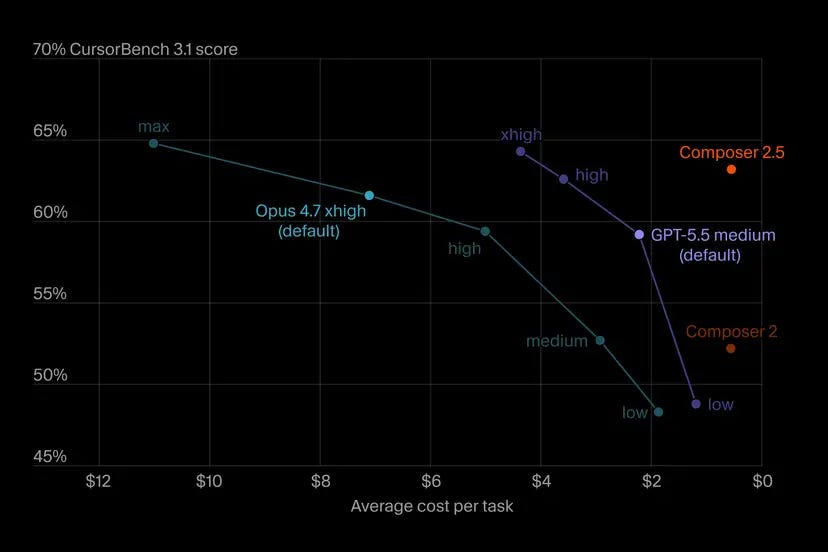
Cursor has officially introduced Composer 2.5, its most advanced AI coding model so far, designed to handle long-running development tasks with stronger reasoning, better instruction-following, and improved reliability. According to Cursor, the new model is significantly more intelligent and up to 10x more efficient than other similarly capable systems. Composer 2.5 was trained using larger-scale reinforcement learning environments and new learning methods that allow the model to improve through detailed text feedback across massive token rollouts. Built on top of the open-source Moonshot Kimi K2.5 foundation, the model focuses heavily on sustained coding workflows rather than short one-shot outputs. Cursor also revealed a partnership with SpaceXAI to train an even larger next-generation model using Colossus 2 infrastructure and nearly 10x more compute power powered by massive H100 GPU clusters. The announcement signals Cursor’s ambition to push AI coding assistants closer to autonomous software engineering systems capable of handling increasingly complex development work.
Hand Picked Video
In this video, we’ll look at a powerful AI skill that helps you write research papers without fake citations, generic content, or hours of editing. It reads your actual project, structures your ideas, and generates a clean, reliable draft that reviewers can trust. If you’re struggling with AI hallucinations or stuck staring at a blank document, this will completely change how you write papers.
Top AI Products from this week
Viberia - Do you like your Claude/Codex pet but wish you had a zoo? Viberia is a spatial command center for your AI agents. Your whole AI org lives on an isometric map, status icons show who’s blocked, who’s asking, who’s done.
Retina - Retina is a Mac screen recorder built for polished demos. Auto-zoom into the action. Cursor paths cleaned into smooth arcs. 4K export, optimized file sizes. Recordings look cinematic out of the box no post-production needed.
mailX by mailwarm - Your emails go to spam. mailX shows you why, and how to fix it in seconds with clear answers and exact steps. Built for humans and AI agents. API and MCP ready.
Multi Claude - Juggling personal and work Claude accounts means constant logging in and out... or a second browser. Multi-Claude is a native macOS app that runs every Claude account you have as a separate profile, each with its own session, history, and settings.
Skilled - Your AI coding tools keep traces. Skilled reads them. Live TUI dashboard that aggregates skill usage across Claude Code, OpenCode, Codex, Grok, and Droid.
Runtime - Turn coding agents into teammates anyone can use from Slack, Linear, CLI, API or your browser. Ship features, query data, build dashboards, automate workflows. All within your company’s context, skills, integrations, and security guardrails.
This week in AI
Karpathy Joins Anthropic - Andrej Karpathy has officially joined Anthropic to focus on frontier LLM research, calling the next few years of AI development “especially formative” for the industry.
The Future of AI in Personal Productivity - An exploration of how AI tools are reshaping personal productivity and workflow management, emphasizing the importance of integrating AI into daily tasks.
Manus Schedules 2.0 - Manus launched Scheduled Tasks 2.0, letting AI agents run recurring workflows inside tasks, projects, and web apps with persistent context and automation.
NVIDIA Cosmos Update - Hugging Face revealed NVIDIA Cosmos fine-tuning for robot video generation, helping AI models create realistic robotics training simulations faster.
Musk Loses OpenAI Case - A jury ruled against Elon Musk in his lawsuit against OpenAI, saying the case was filed too late under the statute of limitations.
Paper Of the day
AutoResearchClaw is a multi-agent autonomous research pipeline designed to mimic how real science actually works iteratively, not linearly. It combines five core mechanisms: structured multi-agent debate (where agents play roles like Innovator, Pragmatist, and Contrarian to stress-test hypotheses), a self-healing executor that treats failed experiments as useful information rather than dead ends, verifiable result reporting that blocks fabricated numbers and hallucinated citations, seven human-in-the-loop intervention modes, and a cross-run evolution system that carries lessons from past attempts into future ones.
On ARC-Bench, a 25-topic benchmark, it outperforms AI Scientist v2 by 54.7%. Notably, its “CoPilot” mode where humans intervene at six targeted decision points achieves an 87.5% paper acceptance rate, outperforming both full automation (25%) and exhaustive step-by-step oversight (50%), suggesting that precise, well-timed human input beats both extremes.
Read this whole paper 👉 here